Arezzo
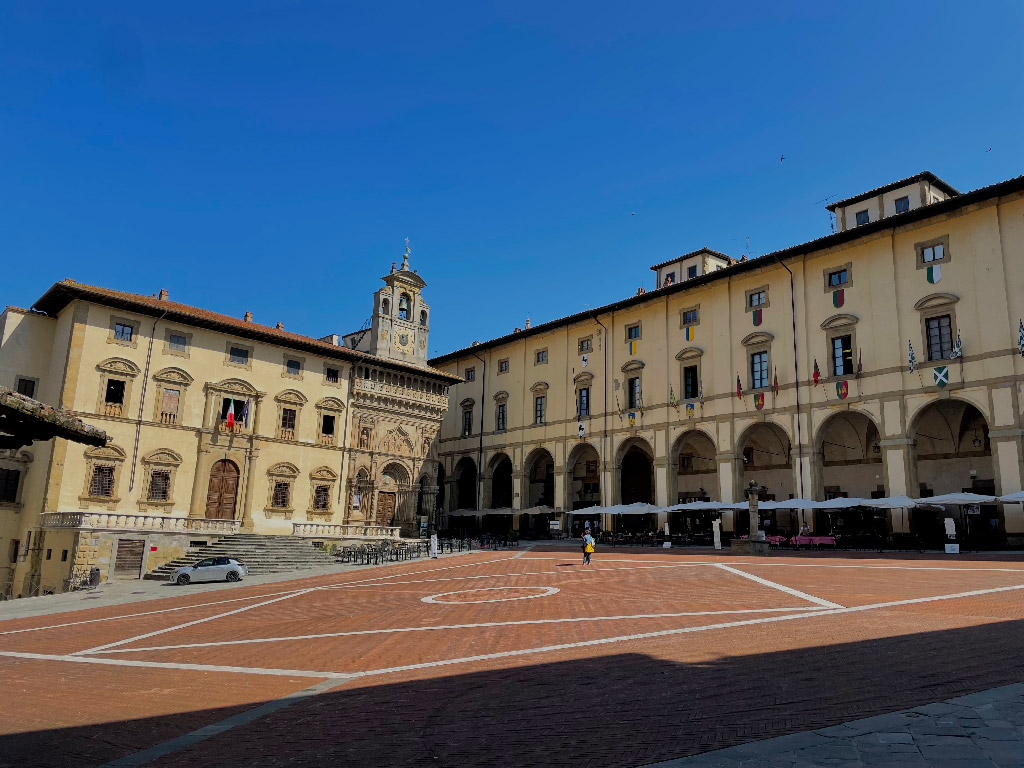
Piazza Grande In the heart of Arezzo
Piazza Grande is one of the oldest squares in the city of Arezzo and one of the most beautiful in Italy. Thanks to the buildings from different eras that overlook the square as if it were a stage, the square boasts an incredible harmony.
The square has irregular structures because it was built on sloping ground. During the age of the city-states it was the seat of the market and during the Renaissance it became the centre of civic life in the city. Its current appearance dates back to the 16th century when the Palazzo delle Logge was built, which now dominates the highest part of Piazza Grande.
The project, signed by Giorgio Vasari, was completed in 1595: the building is distinguished by the simplicity of its architectural lines and the great elegance of its portico. On the west side of the square are the Pieve Santa Maria, the Palazzo del Tribunale and the 15th-century building of the Fraternita dei Laici.
Piazza Grande, made famous worldwide by Roberto Benigni's film 'Life is Beautiful', is the location of the traditional 'Giostra del Saracino'. The Antiques Fair is also held here every first Sunday and the preceding Saturday of the month.
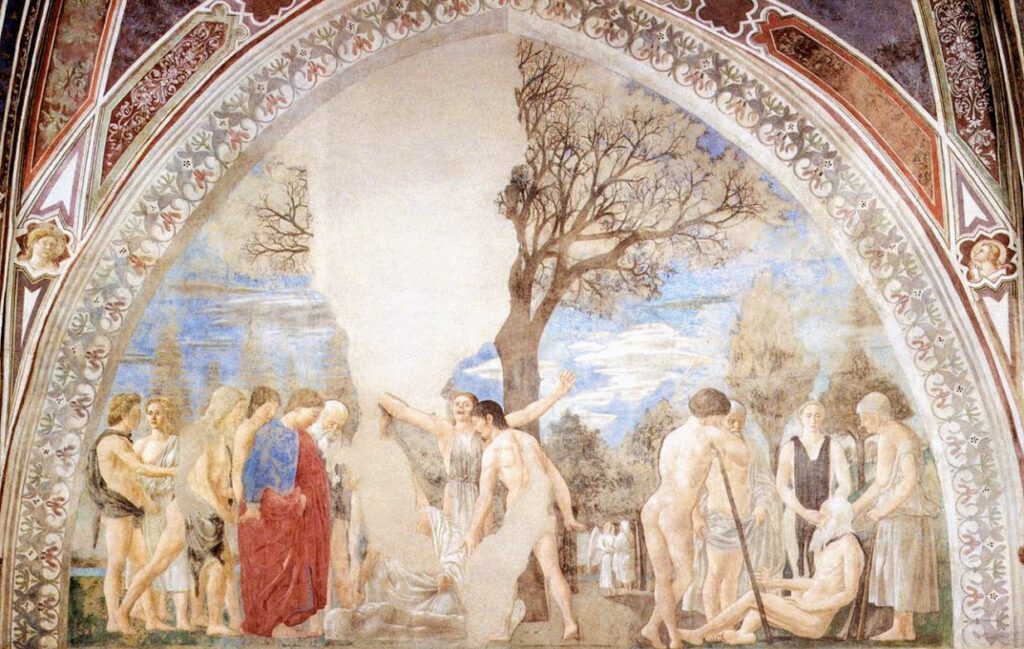
Piero della Francesca The Legend of the True Cross
Piero di Benedetto de' Franceschi, known as Piero della Francesca, was born in 1416 in Borgo Sansepolcro and is one of the most representative and extraordinary artists of the Italian Renaissance.
His works are suspended between rationality and aesthetics, art, geometry and a complex system where theological, philosophical and topical issues come together. One of Piero della Francesca's masterpieces, the cycle of frescoes 'The Legend of the True Cross' (still excellently preserved) is located inside the main chapel of the Church of San Francesco, known as the Bacci Chapel, in Arezzo.
The frescoes in the Bacci Chapel depict outdoor, court and battle scenes where the real protagonist is the wood of the cross of Jesus Christ. Famous is the night scene, located on the bottom right wall, depicting 'The Vision of Constantine' in which Piero della Francesca makes exemplary use of the angel as a source of light in a scene that would have been completely dark. If you are visiting Arezzo following Piero, you can find another masterpiece inside the Cathedral: the fresco Mary Magdalene, painted in 1460 on the left aisle.
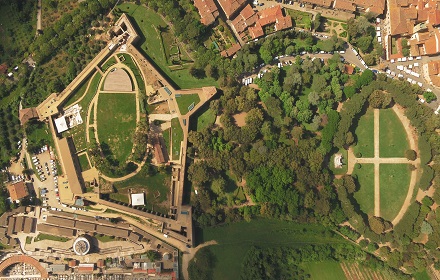
The Medicean Fortress Ancient military architecture with a breathtaking panorama
The Fortezza Medicea is located on the summit of the San Donato hill in the north-eastern part of the city. From this point, at a height of about 300 metres, there is a wonderful panorama of Pratomagno and the Arno valley.
The Fortress is a majestic stone building with a peculiar five-pointed star system. Today it is a public park beloved by the people of Arezzo where archaeological finds dating back to the Middle Ages have been unearthed.
The current structure was built by the Medici following revolts by the local population in order to obtain autonomy and greater freedom. The powerful Florentine family commissioned architect Antonio da Sangallo to design an impenetrable fortress.
Work began in 1538 and was completed in 1560. In order to build an impenetrable fortress, the five bastions were built following different proportions in the ensemble with the hill. Depending on the ground level, the ramparts were larger or smaller, higher or lower. The first restoration work became necessary in 1868 after the French army attempted to bring down the fortress with mines.
On the west side, large gashes caused by mine explosions are still visible. Today, it is a meeting point for locals and tourists from which one can enjoy a breathtaking view.
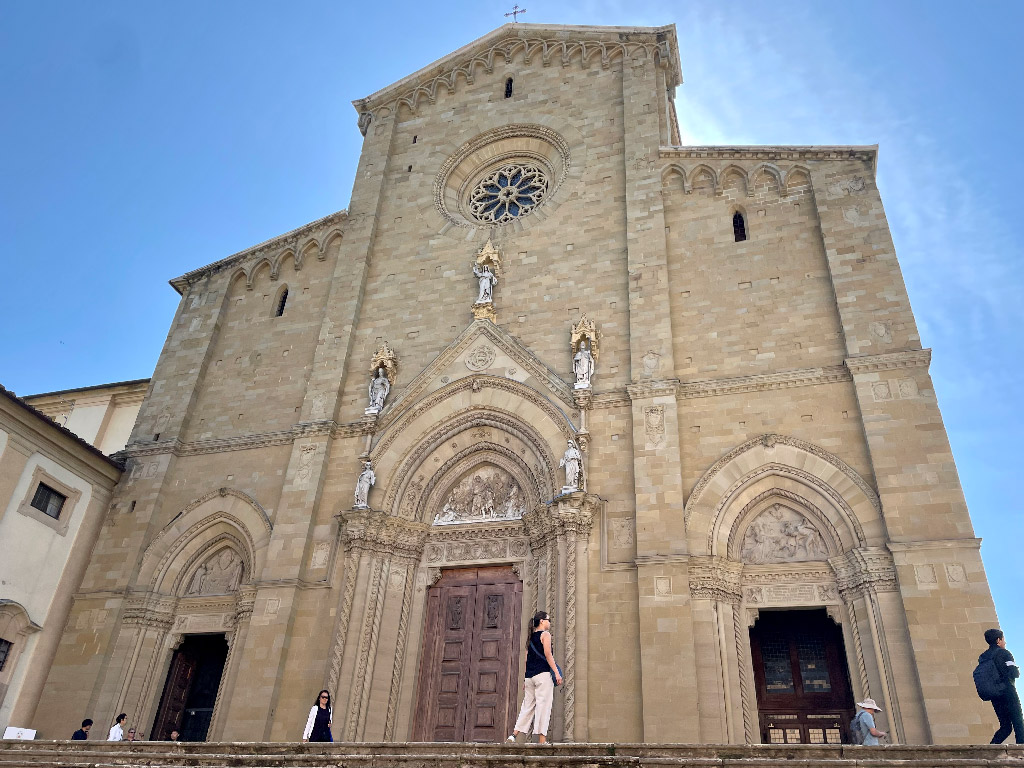
The Cathedral The Cathedral of St Peter and St Donatus
The Cathedral of Saints Peter and Donato, the Duomo of Arezzo, is the city's main place of worship. Construction began in 1278 by Bishop Guglielmo degli Ubertini, and was completed in 1511 although it was interrupted several times.
The exterior façade was laid out, as we see it today, between 1900 and 1914. The three-nave interior is characterised by a polygonal apse. The seven stained glass windows of the Marcillat cycle are masterpieces and the artist also designed the imposing staircase leading to the basilica.
Inside the cathedral are several works by great artists with ties to Arezzo. These include: The fresco of Mary Magdalene by Piero della Francesca and the wooden choir of the high altar designed by Giorgio Vasari. The illustrious artist was also responsible for the design of the organ pedestal along the left aisle. The altarpieces by Andrea della Robbia are located in the chapel 'La Madonna del Conforto'.
The Gothic-style bell tower, whose singular profile is visible from every access point to the city, has a hexagonal plan divided into four superimposed orders by cornices.
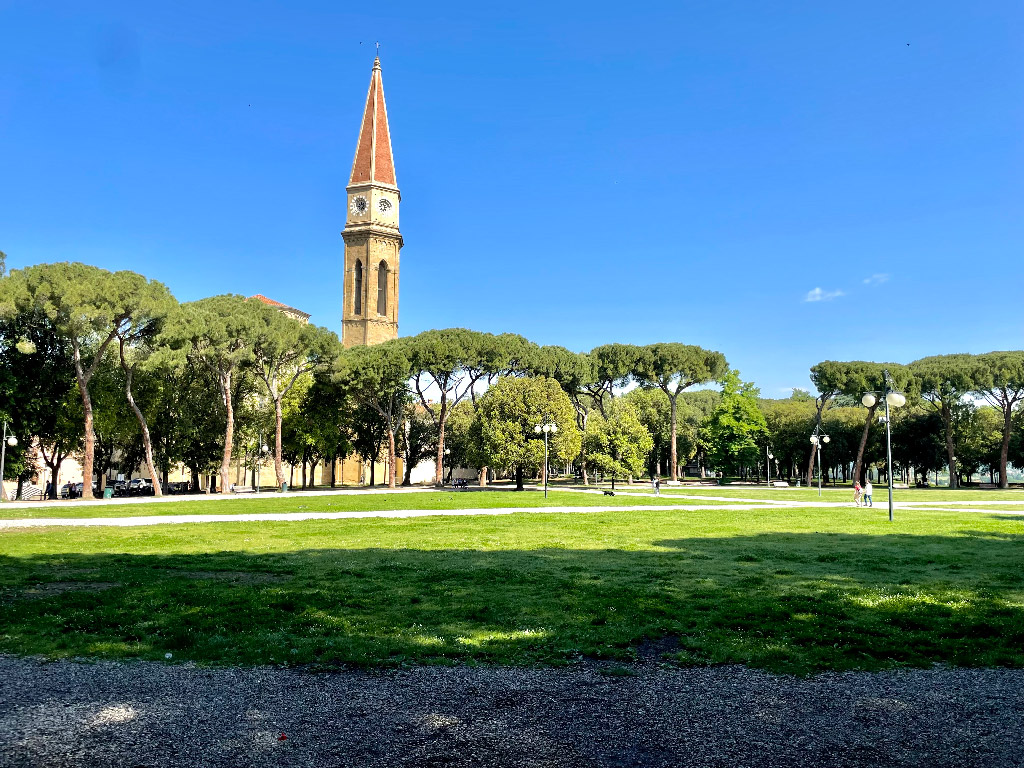
The Lawn The city's green lung
At the top of the hill where the city stands, nestled between the Duomo and the Medici Fortress, the Prato di Arezzo is the oldest in the city. This large green expanse of elliptical shape, surrounded by a crown of ancient maritime pines, was created during the Medici era as a stately pedestrian park.
In 1928, King Vittorio Emanuele II decided to place a large monument dedicated to Francesco Petrarca, the great 14th-century poet from Arezzo, in the centre of the Prato.
Today, the Lawn is the park for nature lovers in the heart of the city, it is the natural setting for the scenic Antiques Fair in September, festivals, live music and is perfect for moments of relaxation. The Lawn is the perfect place to relax with the family, play sports or dive into history.
From the Prato we can access the beautiful Fortezza Medicea, which hosts important contemporary art exhibitions during spring and summer. The Prato is in constant dialogue between past and present, art and history, Etruscan and Roman excavations and present-day creations.
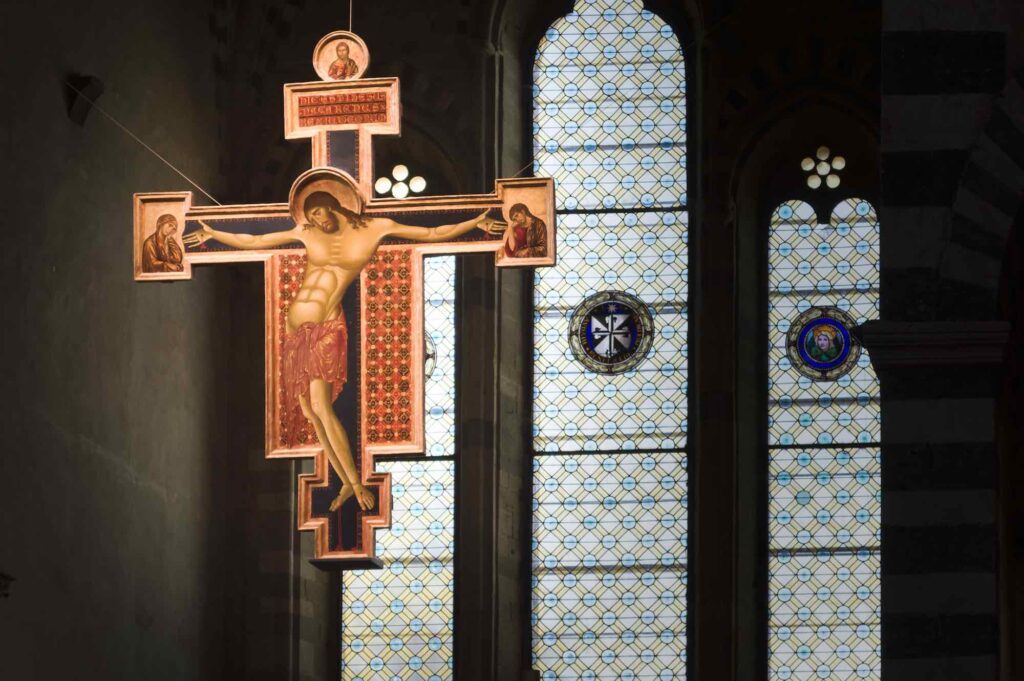
Cimabue The Crucifix of San Domenico
Cimabue, pseudonym of Cenni Bencivenni di Pepo, was born in Florence around 1240. He is credited with a fundamental step in Western painting: the transition from the hieratic and idealised figures of the Byzantine tradition to real subjects, endowed with humanity and emotion.
The San Domenico Crucifix in Arezzo is a splendid moulded cross painted in tempera and gold on wood, dating from around 1268-1271 and is the earliest work attributed to Cimabue. The crucifix shares with the world the extraordinary artistic wealth of Arezzo. According to historians, Cimabue finished the wooden cross between 1265 and 1271 and has not left the Church of San Domenico since then.
The black and white stripes decorating the corners of the central chapel, behind the high altar, enhance and highlight the work of the Florentine painter. The splendour of this work is the product of two restorations in 1917 and 2005. The blue stained-glass windows behind the cross and the warm colours of the work create a strong and striking contrast.
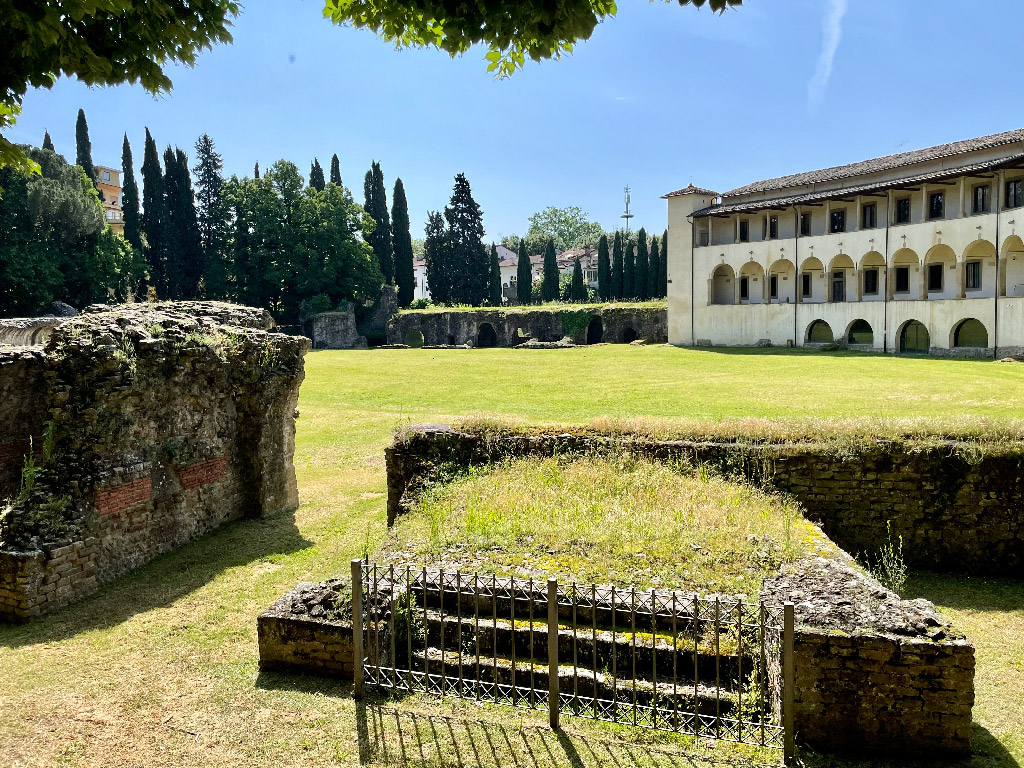
Roman Amphitheatre
Site of Roman artefacts and site of the Archaeological Museum of Arezzo
The Roman Amphitheatre is an archaeological site from Roman times located in the southern area of the 'walled city'. Probably built by Emperor Hadrian (117-138 A.D.), it bears witness to the strategic importance of Arezzo for the 'Eternal City'.
The monument has undergone several transformations and was first explored around 1915. The excavations, which were interrupted due to the war, were resumed in 1926. Since 1950, the monument has undergone periodic restoration that has completely brought it to light. On one side of the perimeter of this ellipsoidal structure, the Monastery of St. Bernard was built in the 14th century.
Today it is home to the Gaio Cilnio Mecenate Archaeological Museum. Built for city celebrations and festivals, Arezzo's Roman amphitheatre could seat 80,000 people. Today it hosts events, shows and concerts during the summer. Its history and various remains from Roman times are preserved in the rooms of the Archaeological Museum.
It is a must for those who want to immerse themselves in ancient Rome in Arezzo and experience the grandeur of this magnificent era.
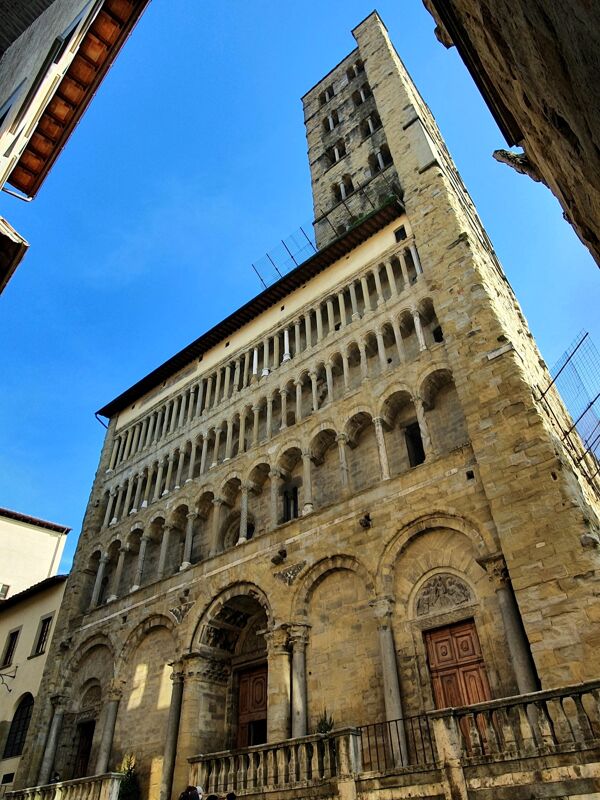
La Pieve
The facade in Corso Italiaparallel of Piazza Grande. The Parish Church of Santa Maria Assunta in Arezzo is the link between two of the most important and lively places in the city. Built from the year 1000 onwards, this Romanesque parish church presents itself in all its magnificence with a façade of three portals. We all look at the parish church with our noses in the air, because we cannot fail to be fascinated by its bell tower, known as 'of the hundred holes' because of the mullioned windows, once ten on each side, that make it unique.
At the rear of the church is the large semicircular apse: small single-lancet windows illuminate the interior of the crypt where the 1346 silver-gilt bust-reliquary containing the relics of San Donato Vescovo, the Patron Saint of Arezzo, is kept.
One need only cross its threshold to admire, inside, a masterpiece of 14th-century painting: the Polyptych with the Virgin and Child and Saints John the Evangelist, Donatus, John the Baptist and Matthew commissioned from Pietro Lorenzetti in 1320, not to mention the beautiful Chapel of the Blessed Sacrament, where delicate pastel-coloured frescoes by maestro Luigi AdemolloThey frame a sweet 15th-century statue of the Madonna in polychrome terracotta.
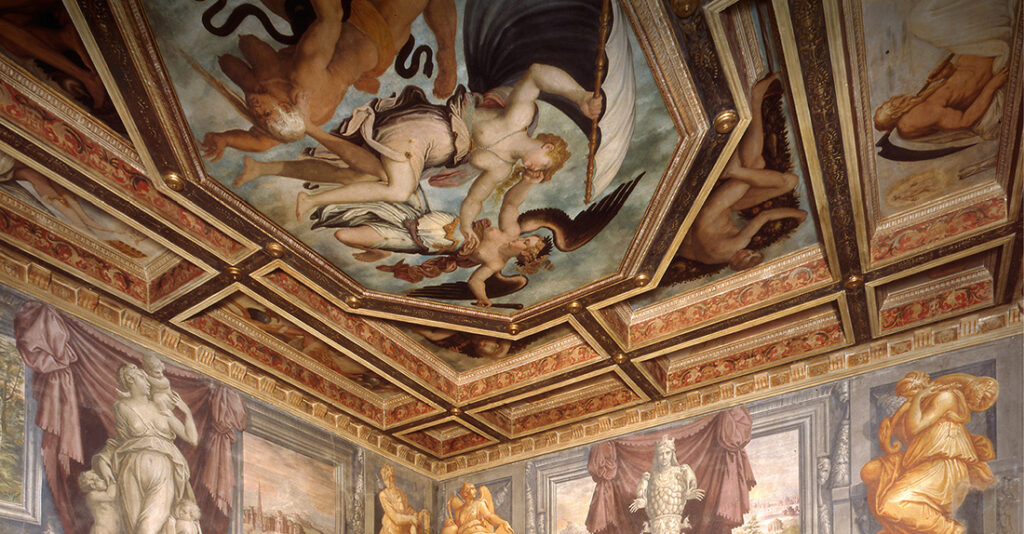
Museo di Casa Vasari
“Ho comprato casa ad Arezzo, nel sobborgo di San Vito, dove l’aria è la più pura della città”: così Giorgio Vasari descriveva nel 1541 quella che oggi è la sede del suo museo. L’illustre autore de Le Vite, nonostante i continui viaggi, vedeva in questa dimora il suo rifugio rigenerante. L’artista non si limitò ad abitarla, ma ne trasformò il piano nobile in un manifesto della propria arte, decorando soffitti e pareti con un ricco programma iconografico di temi mitologici e biblici.
Oggi, oltre alle sale affrescate, il museo ospita una preziosa quadreria con opere dei “pittori dello studiolo” (collaboratori di Vasari a Palazzo Vecchio) e si affaccia su un raffinato giardino pensile all’italiana. La casa custodisce inoltre il cuore documentario della sua vita: l’Archivio Vasariano, scrigno di lettere e memorie private.
Biglietto
Whole: € 4,00 / Ridotto: € 2,00
BIGLIETTERIA
Museo di Casa Vasari
Via XX Settembre, 55

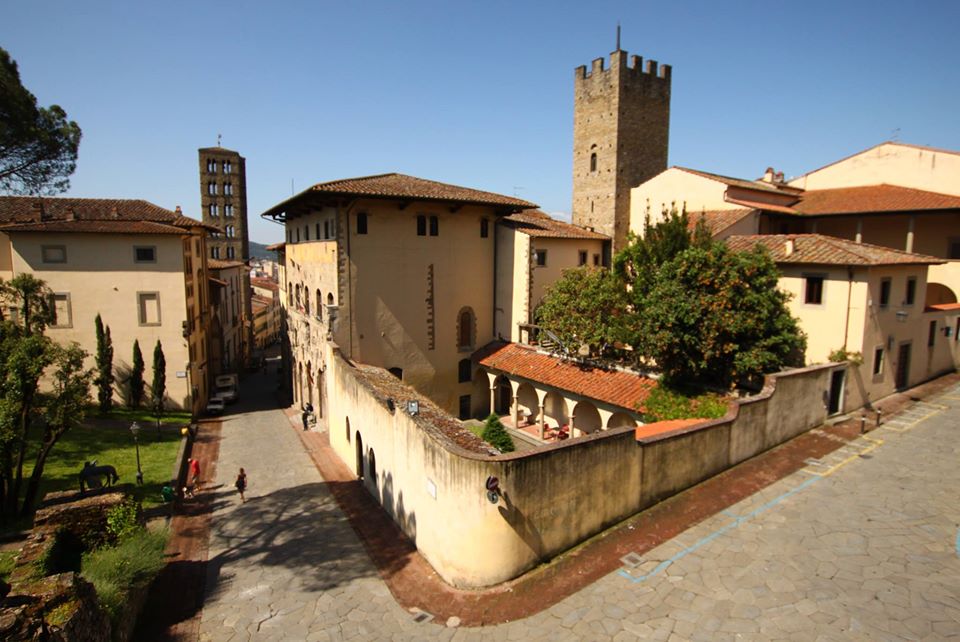
Petrarch House
Petrarch was born in this house, which still retains so much history, to Eletta Canigiani and Ser Petracco, a Florentine exile.
What you will now see is a building dating back to the late 15th century that was a private estate for many years. When it was restored in 1926, traces of an earlier building from the 14th century came to light.
Memories of his life as well as portraits and an infinity of letters of expectation to make you relive the story of this poet who, you might think, in 1350 on his way back from the jubilee in Rome stopped in Arezzo and was celebrated by his fellow citizens who took him to his birthplace.
Ivan Bruschi House Museum
"A 'place of wonders' in the heart of the city, where the aesthetic and cultural philosophy of its founder, an antiquarian and collector, is still alive thanks to the evocative display of the precious and eclectic collection.
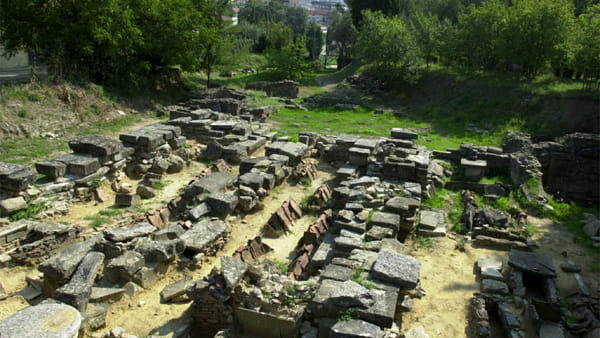
Pionta Hill
The Pionta Hill is a fascinating historical site located outside the medieval walls of Arezzo, but once considered the beating heart of the city. It has been called the 'Vatican of Arezzo' and is remembered as the true historical memory of the people of Arezzo. The hill has had an important history, with an ideal line connecting it to other significant places such as Poggio del Sole and Olmo, where the Etruscan necropolis of Arretium was supposedly located.
The place name has Longobard origins, indicating a breeding enclosure rather than a fortification. An early Christian church was first built on the hill, followed by the cathedral of Santa Maria and Santo Stefano in Longobard times. This cathedral became the power centre of the bishop counts of Arezzo, who were Ghibellines, close to the German emperors.
The building was designed by Maginardo, inspired by the basilica of San Vitale in Ravenna and was the cultural centre of the city, hosting personalities such as Guido Monaco and the university. However, in 1203, the bishop's seat was moved within the city, leading to the decline of the Pionta complex due to looting and lack of maintenance.
In 1561, the complex was demolished by order of Cosimo I de' Medici, Lord of Florence, due to its involvement with opposing militias. Today, the Pionta Park is an elegant garden near the historical centre, where one can admire some of the excavations of ancient churches and enjoy a beautiful view of the city.
 English
  Italian
  French
  German
  Dutch
Dutch  Spanish
  Portuguese