Around Arezzo
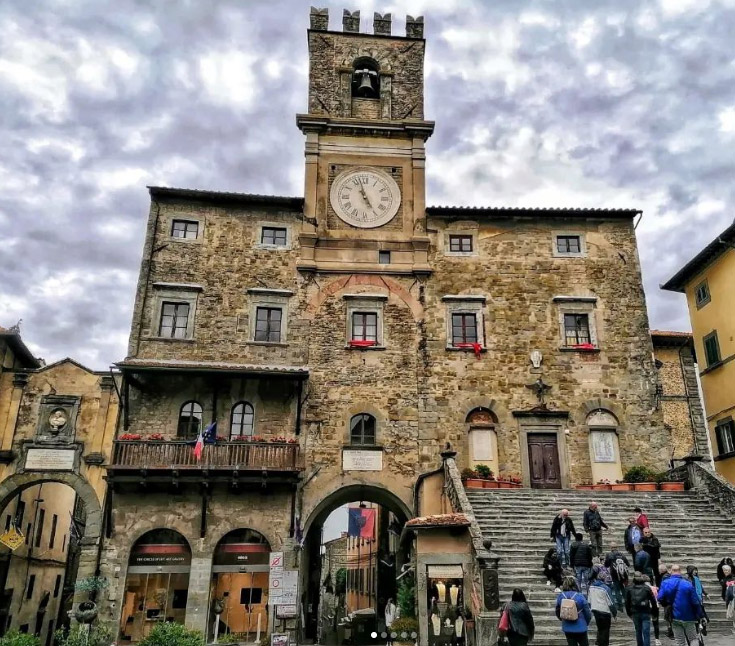
Cortona
30 km from Arezzo, easily reached by car
A beautiful town of Etruscan origin, Cortona is an essential stop for tourists visiting the province of Arezzo.
Perched on a hill 500 m above sea level, the strategic location chosen by the Etruscans is close to today's border between Umbria and Tuscany, allowing visitors to reach many interesting places through short trips.
Thanks to this fortunate position, between the 8th and 7th centuries BC Cortona became an important Etruscan lucumonia. Today Cortona is a lively town that blends past, present and future; the beautiful town centre with its streets, churches and museums evokes the ancient splendours of Etruscan and Roman times at every turn, while its summer is filled with contemporary artistic and cultural events.
Among the many attractions in Cortona, we suggest visiting the Girifalco Fortress, the Franciscan hermitage Le Celle and the MAEC Museum of Etruscan Art in Cortona.
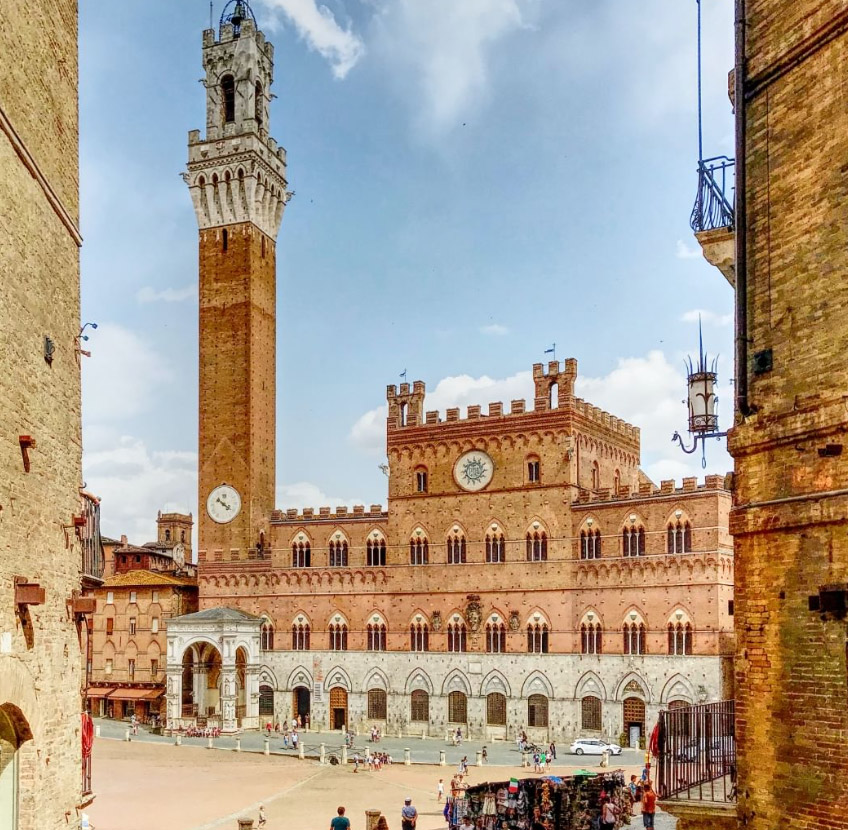
Siena
70 km from Arezzo, easily reached by car
The city of Siena is about 1 hour's drive from Arezzo.
Siena is situated in the Tuscan hills, protected by ancient Etruscan walls.
It is famous for its great historical, artistic and landscape heritage and for the stylistic unity of its medieval urban layout.
Here, time seems to have stopped in the 13th century, when Siena was enriched with an artistic and architectural heritage that has consecrated its beauty forever.
To describe Siena, we must start with its main square, Piazza del Campo, where the famous Palio takes place and where tourists and locals alike stop to admire the surrounding monuments. The square has a peculiar trapezoidal shape, gently sloping down towards a replica of the 15th-century masterpiece by sculptor Jacopo della Quercia, the Fountain of Gaia.
Siena is a city on a human scale, a unique place of rare beauty with its alleys full of craft workshops and narrow sandstone streets where you can breathe in the enchanting atmosphere of the city.
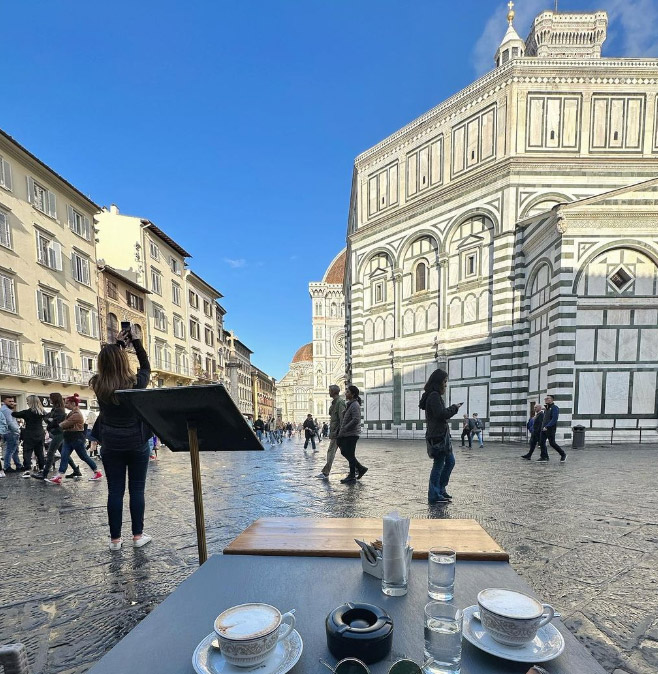
Florence
80 km from Arezzo, easily reached by car or train (recommended)
This Tuscan city needs no introduction.
Florence is the cradle of the Renaissance, an important university centre, a UNESCO World Heritage Site since 1982, and home to immortal artists and poets such as Dante, Petrarch, Giotto, Brunelleschi, Botticelli, Leonardo da Vinci, Michelangelo and Galileo.
Florence lies in the centre of a shell-shaped valley, resembling an amphitheatre crossed by the Arno, and is a veritable collection of treasures, one of the most beautiful cities in the world. The beating heart of the city is Piazza del Duomo, with the monumental complex of the Basilica of Santa Maria del Fiore crowned by Brunelleschi's dome, the Baptistery of San Giovanni and Giotto's bell tower, a masterpiece of Florentine Gothic architecture.
Behind the cathedral is the Museo dell'Opera di Santa Maria del Fiore where you can admire a collection of works from the cathedral, the Baptistery and the bell tower. Piazza della Signoria is the centre of civic life with its beautiful Neptune Fountain and Palazzo Vecchio.
A few steps away, the majestic Uffizi Gallery is one of the most important museums in the world, including works by Botticelli, Michelangelo, Leonardo da Vinci and many other great artists.
Florence is this and more, it never ceases to amaze!
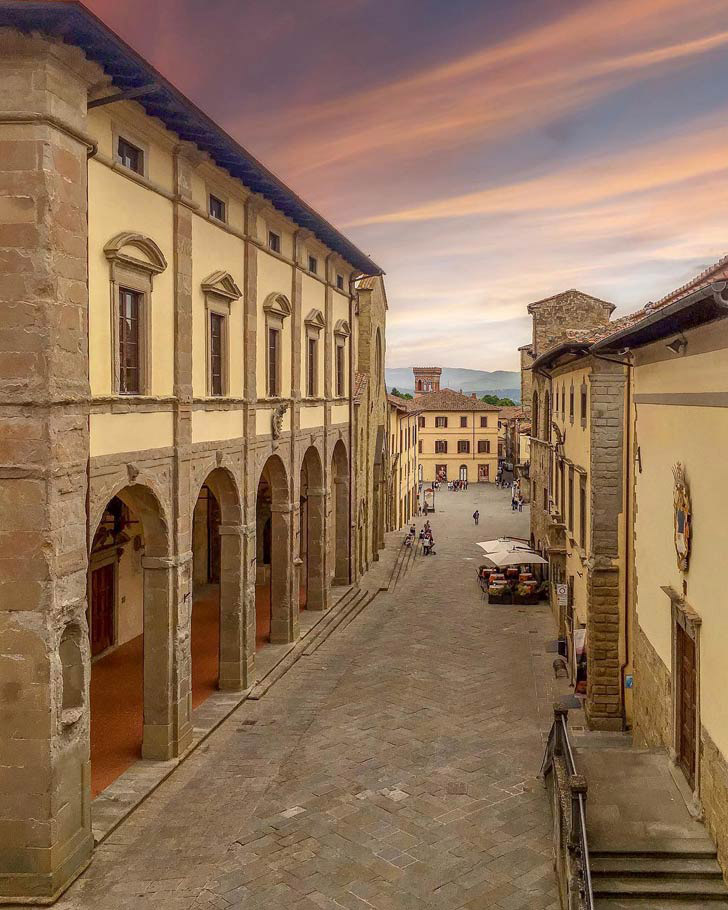
Sansepolcro
37 km from Arezzo, easily reached by car
Located north-east of Arezzo, on the banks of the Tiber River, at the far eastern end of Tuscany, at the crossroads of four regions (Tuscany, Marche, Umbria and Emilia Romagna), Sansepolcro is the most populous city and capital of the Tuscan Valtiberina .
Sansepolcro boasts a Renaissance historical centre rich in works of art and numerous interesting and varied museums, first and foremost the Museo Civico, which houses the extraordinary paintings of Piero della Francesca.
This artist, who originally liked to sign himself 'Pietro del Borgo', immortalised his hometown in his works, exalting its features and characteristics to bring it closer to the 'ideal city' that was much talked about in Italian courts at the time.
Today, Sansepolcro is an active and modern city of about 15,600 inhabitants, which, while committed to safeguarding its noble past and traditions, identifies itself as a city of design and looks to the future with cultural initiatives and investments in craftsmanship.
Poppi
40 km from Arezzo, easily reached by car
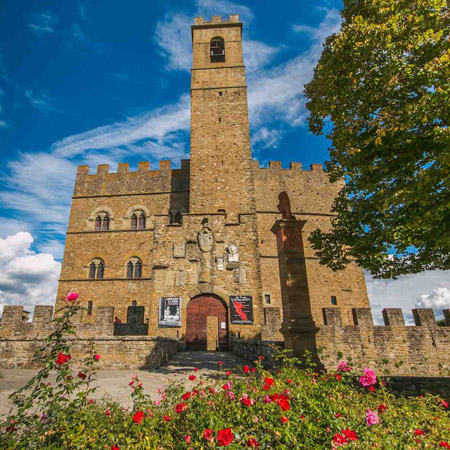
The medieval village of Poppi, in the beautiful Casentino valley, is unique thanks to the imposing castle of the Conti Guidi family, which dominates the entire old town and much of the valley below.
The castle dates back to the 13th century and is one of the most visited monuments in the province of Arezzo. The chapel inside the castle preserves the fresco cycle of the 'Stories of the Gospel' by Taddeo Gaddi, Giotto's main pupil.
The castle displays a miniature model of the Battle of Campaldino, which took place on 11 June 1289, with 4302 figures in tin and lead. The ancient building is also home to the Municipal Library, divided into 2 sections: the historic Rilliana, named after the founder Count Rilli-Orsini, with 25,000 ancient books from the medieval period, and the modern Vettori with around 30,000 books.
The village, surrounded by imposing walls, has a beautiful and interesting architectural harmony that makes the visit particularly pleasant.
One breathes an enchanted place, with an atmosphere suspended in time.
Poppi is one of the most beautiful villages in Italy.
Anghiari
48 km from Arezzo, easily reached by car
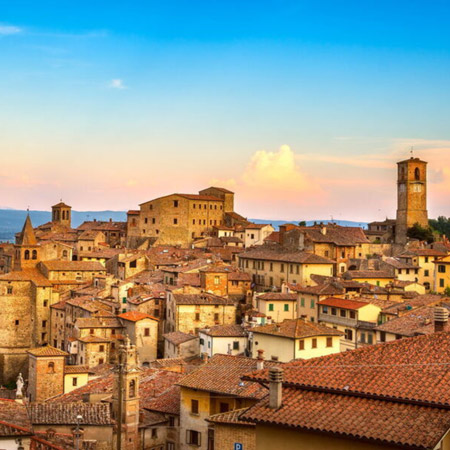
Anghiari is a beautiful medieval village located in the territory delineated by the courses of the Tiber and Arno rivers. It is an impregnable bulwark, thanks to its heavy 13th-century walls.
The famous Battle of Anghiari of 9 June 1440, frescoed by Leonardo da Vinci in Florence's Palazzo Vecchio, reaffirmed Florentine hegemony in Tuscany. The Museum of the Battle of Anghiari, which celebrates this important historical event, is housed in the Palazzo della Battaglia and, together with a documentation centre, promotes the area through educational tours and events.
The passage of time has left important marks on the churches and buildings in the historical centre of Anghiari, developing an urban layout along the stepped road (ruga) that crosses the town, making it unique and unmistakable.
Anghiari, surrounded by churches and castles, enjoys the splendid scenery of the Tiber valley, a natural amphitheatre of Franciscan spirituality.
Anghiari can be visited all year round thanks to its cultural vitality: it is home to fairs, exhibitions and popular festivals.
Parish Church of Romena
Pratovecchio, 48 km from Arezzo, reachable by car
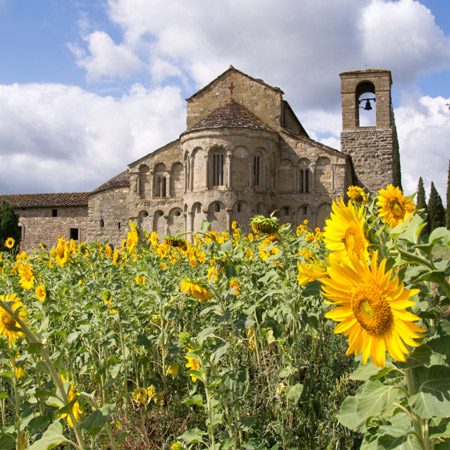
Beautiful and charming, Pieve di S. Pietro a Romena is set in a fairytale landscape in the heart of the Casentino valley, immersed in the green Tuscan countryside.
The Pieve di Romena is part of the most important and significant complex of Roman buildings in Casentino. It has similar characteristics to the parish churches of Stia, Vado and Montemignaio, all characterised by a basilica layout with naves divided by monolithic sandstone columns where decorative elements in relief are only present in the sculptures of the capitals.
These characteristic elements are carved differently from each other with motifs ranging from angels, fierce animals, real or mythological, through flowers, leaves and biblical stories.
Today the Pieve is a place of mystical recollection, prayer and deepening. It is the meeting and departure point for all those who seek themselves and answers, following the Gospel passages.
In this place of peace and simplicity, immersed in the silence of nature, Dante took refuge during his exile and Gabriele D'Annunzio wrote the poems of his collection Alcyone.
Hermitage of Camaldoli
46 km from Arezzo, easily reached by car
Camaldoli, founded 1000 years ago by St Romuald, is a community of Benedictine monks.
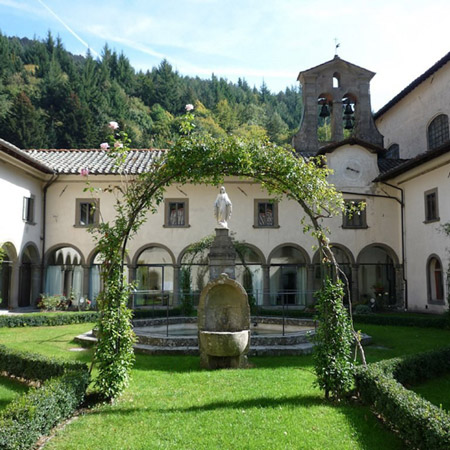
Its two houses, the Sacred Hermitage and Monastery, immersed in the peace of the forest, represent two fundamental dimensions of the monastic experience, solitude and communion.
The forest offers a spiritual and cultural space, a space for dialogue and encounter open to all. The Sacred Hermitage of Camaldoli, which houses the ancient cell of San Romualdo, is located within the splendid area, immersed in the Casentino Forests.
Today the cell is incorporated into the library building, maintaining the typical structure of the hermit cell: a corridor that opens on three sides, preserving the monks' living spaces inside: bedroom, study and chapel.
This sinuous structure not only offers shelter from winter conditions, but also symbolises the monk's inner journey. Camaldoli and its Hermitage are magical places to visit all year round, a perfect breath of fresh air during the summer and a place rich in spirituality.
Sanctuary of La Verna
48 km from Arezzo, reachable by car
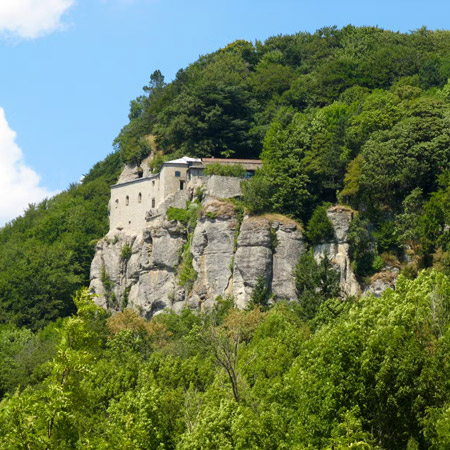
La Verna is one of the beating hearts of the cult of St Francis, a destination for many pilgrims and visitors in search of peace and spirituality.
The Sanctuary of La Verna, located on Monte Penna in the Casentino Forest National Park, is famous for being the place where St Francis received the stigmata on 14 September 1224.
It contains numerous chapels and places of reflection, and together with Camaldoli represents the most sacred place in the Casentino and the entire province of Arezzo. The sanctuary is still home to a community of Franciscan friars who welcome all people, especially pilgrims seeking a time of prayer, reflection and spiritual help from St Francis.
At La Verna it is possible to participate in the prayers and celebrations of the friars. The friars are available for confessions and talks, and also act as tour guides to the shrine.
Visiting the monastery complex, one can enjoy a silent and contemplative day immersed in nature.
San Gimignano
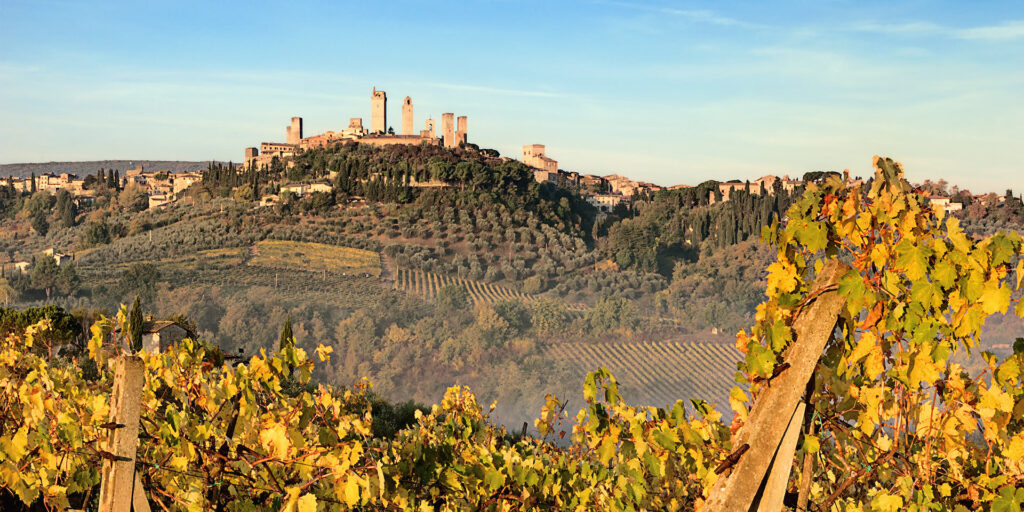
San Gimignano is a hill town in Tuscany located south-west of Florence. Surrounded by 13th-century walls, the centrepiece of its historic centre is Piazza della Cisterna, a triangular square lined with medieval houses. In the skyline of medieval towers, the stone Torre Grossa stands out. The Cathedral of San Gimignano is a 12th-century church where you can admire Ghirlandaio's frescoes in the Chapel of Santa Fina
Montalcino
Montalcino, city of Brunello
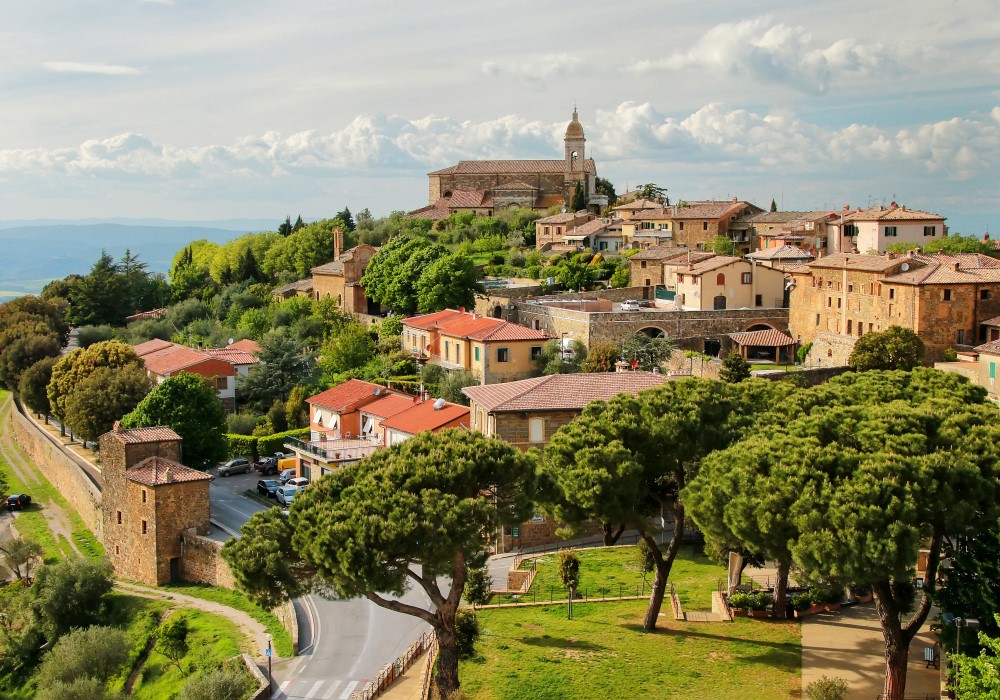
South of Siena lies an enchanting, almost fairy-tale medieval village, surrounded by mighty walls and dominated by an ancient castle of authentic architectural perfection. Montalcino, to the west of Pienza, is a beautiful historical town immersed in the splendid landscape of the Val d'Orcia Natural Park and renowned throughout the world for the extraordinary production of the precious Brunello di Montalcino.
The village has remained virtually intact since the 16th century. Once you reach the summit on which Montalcino stands, a veritable spectacle opens up before your eyes: a continuous succession of sinuous hills dotted here and there with yellow and red flowers, ancient oaks, picturesque olive trees, scenic country roads winding through harmonious vineyards and isolated cypress trees here and there.
Bagno Vignoni
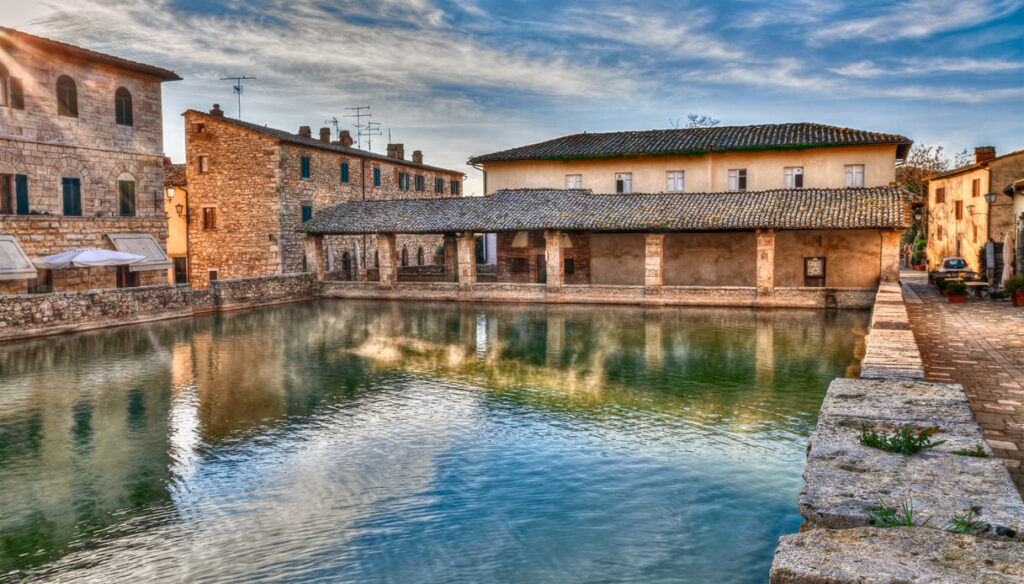
Bagno Vignoni is one of those places in Tuscany that is very famous despite its size not being comparable to that of a small town. Why? Of course, the reason lies in its old-world charm, but not only that... it is also due to the presence of the thermal baths! This is why I recommend adding a stop to your itinerary and stopping at Bagno Vignoni, also to enjoy the magnificent and famous views of the Val d'Orcia, including the Rocca di Tentennano in Castiglione d'Orcia.
 English
  Italian
  French
  German
  Dutch
Dutch  Spanish
  Portuguese